
Foundation Condition Mapping on the A1(M), UK: Overcoming Traffic Disruption Challenges with MASW Technology
The A1(M) motorway required an assessment of the chalk bedrock and any potential voiding for planned maintenance works. The works required included a Multi-channel Analysis of Surface Waves (MASW) survey along the six lanes of a section of both the north and southbound A1 carriageway.
More traditional investigation methods would cause significant traffic disruption on a large stretch of such a critical transportation route - creating possible safety risks and frustrations among road users, while limiting the scope of the investigation.
Project Description and Overview
SOCOTEC UK & Ireland was commissioned to begin the survey in January 2025. The aim was to help reduce disruption time with a non-intrusive assessment of pavement foundation conditions using advanced geophysical techniques.
The survey mapped variable superficial deposit and chalk bedrock conditions over areas that exhibited pavement cracking and slumping.
The project required the continuous profiling of bedrock stiffness properties along a 250-metre section of active motorway, without much disruption of traffic flow or compromising road safety.

Using MASW Technology
SOCOTEC's Solution
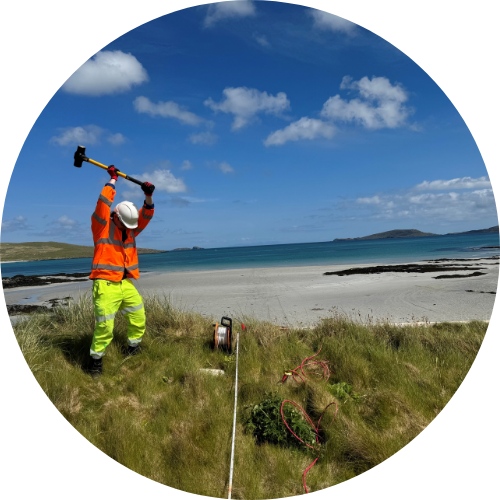
SOCOTEC’s geophysical experts devised a multi-channel analysis using MASW technology. MASW itself is capable of detecting variations in Shear wave (S-wave) velocity within the upper 30-metres of the ground.
An ABEM Terraloc Pro 2 system was utilised to survey the site, with 48 geophones connected via cabling, the system was capable of acquiring high resolution seismic data for forward modelling.
Data was collected at a shot interval of 2-metre along each survey line, with geophones positioned every 2-metres – with the survey itself taking six nights to complete and each 250-metre survey line being broken down into smaller lines in order to account for the road curvature.
This non-intrusive methodology enabled complete foundation assessment, all while maintaining normal daytime traffic operations – reducing the amount of time road users were impacted by the works
SOCOTEC’s geophysical experts devised a multi-channel analysis using MASW technology. MASW itself is capable of detecting variations in Shear wave (S-wave) velocity within the upper 30-metres of the ground.
An ABEM Terraloc Pro 2 system was utilised to survey the site, with 48 geophones connected via cabling, the system was capable of acquiring high resolution seismic data for forward modelling.
Data was collected at a shot interval of 2-metre along each survey line, with geophones positioned every 2-metres – with the survey itself taking six nights to complete and each 250-metre survey line being broken down into smaller lines in order to account for the road curvature.
This non-intrusive methodology enabled complete foundation assessment, all while maintaining normal daytime traffic operations – reducing the amount of time road users were impacted by the works
Conclusion
MASW successfully generated shear wave velocity profiles to a 30-metre depth, identifying weak zones in the bedrock and correlating findings with known problem areas.
Shallow variations in S-wave velocities were identified beneath the carriageway, as well as large scale anomalies up to 30-metres wide – all of which were identified and supplied to the client, alongside 1D S-wave profiles.
The technique proved cost-effective compared to extensive intrusive investigations, providing continuous stiffness variation mapping that directly informed targeted remediation strategies.
This approach was so successful that it is now recommended for similar highway applications requiring foundation assessment without major operational disruption.
Need our MASW solution on your project?
Discover our latest News & Media

Mass Data Capture in Modern Surveying

A Good Flow Survey (It’s All about data) – Part 3 of 3

A Good Flow Survey - Part 2 of 3

A Good Flow Survey (Overview) – Part 1 of 3

Understanding Utility Surveys & PAS 128