Need some advice?
Leave your details and we will get in touch.
I want to be contacted by an expert
1 /

PFAS are per and poly fluorinated compounds in multiple different classes, determined by their varied chain length, functional groups, and polymeric structure.

PFAS is ubiquitous in the environment, due to the strong carbon-fluorine bonds. As PFAS is so prevalent, ensuring there is no cross contamination in the sampling and analysis process can prove to be a challenge, but is essential to get right.
Sampling Best Practice
The usual standards apply, but with a bigger emphasis placed on avoiding materials containing PFAS. As always, materials must be clean and there can’t be anything interfering with the sample. Common materials used contain PFAS, so the usual equipment for sampling and clothing worn may need to be adjusted.
Materials to avoid when sampling due to PFAS content are:
It’s paramount that approved PFAS-free sample containers supplied by the laboratory are used as not all sample containers are PFAS-free. Typically, plastic containers are used because PFAS can adhere to surfaces such as glassware. The container must be kept sealed until the sample is ready and the cap must not be left off in order to avoid PFAS being introduced to the container from external sources. Also, ensure the container is on a surface that won’t be impacted by PFAS, nowhere that could get wet, for example.
Where possible, it is best to plan the sampling sequence, beginning with sampling suspected low PFAS-contamination areas first, before progressing to suspected sources. This avoids PFAS cross contaminating the equipment, or PFAS accidentally being carried between sites, which would impact sampling results.
The decontamination of equipment is essential in order to keep everything PFAS-free. Tap water and many surfactants often contain PFAS, so just rinsing equipment can often make it worse. Ensure the materials used for decontaminating sampling equipment are certified as PFAS-free or supplied by the laboratory.
Sample Preparation
Due to the varying nature of the different classes of PFAS, solid phase extraction (SPE) is the preferred solution for liquid samples, with extraction methods for soils and waters based upon USEPA1633.
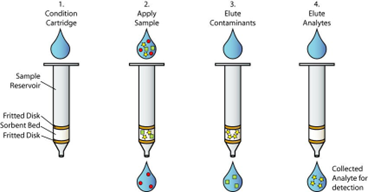
Image from the webinar powerpoint, sourced from https://www.specartridge.com
Sample prep process:
Sample Analysis Considerations
PFAS is present everywhere, including in many items found in a laboratory. The analytical system is an LC-MS/MS system – liquid chromatography with a tandem mas spectrometer, and the tubing potentially contains PFAS. Every method used at SOCOTEC has been tested and proven to be PFAS-free, but the LC system is difficult as there are some PFAS compounds that come from the system itself. We use a small analytical column (PFAS Delay Column) that sits before the sample is introduced to move the inherent PFAS in the system away from the analytes of interest.
It’s crucial to inform a laboratory if samples are coming from a highly contaminated area, especially if it’s something such as an aqueous film forming foam for firefighting (AFFF), or from an area where AFFF has been used. Some of the PFAS compounds can be incredibly sticky and can stay in the LC system after analysis, leading to a system being out of action for several days to decontaminate.
There are lots of considerations for the PFAS sampling process and it’s important to stay aware of the potential sources of cross contamination, from the clothing worn to equipment used. Laboratory analysis for PFAS combines high-end analytical techniques such as LC-MS/MS, with good control of sample integrity to avoid PFAS cross contamination at every stage of the process. Please contact us if you have any queries regarding PFAS sampling.
Want to find out more about accurate sampling and analysing...