Need some advice?
Leave your details and we will get in touch.
I want to be contacted by an expert
1 /

Asbestos management guidelines haven’t been updated since The Control of Asbestos Regulation 2012 (CAR), over a decade ago. The state of asbestos in the UK has evolved since then, and the legislation should be updated to reflect this as the current regulations are no longer sufficient.

The current asbestos regulations ensure a suitable and sufficient assessment of buildings with asbestos is carried out, and that if asbestos is present, the duty holder must manage the asbestos in non-domestic premises and employ a plan to prevent exposure. If the Asbestos-Containing Materials (ACMs) are not damaged or at risk of damage, they will stay in place and remain managed to prevent exposure – only to be removed if exposure is imminent.
The lifespan of ACMs is not infinite, and they have now been in our buildings for a minimum of 27 years, only completely banned in 1999. The fact that ACMs are now approaching the end to their lifespan should be a consideration when managing ACMs.
A lot of asbestos cement in the UK is 70+ years old – exceeding its average lifespan of 40 years. For example, all asbestos cement roof sheets in the UK will be past their average lifespan by 2039. An effective management plan should consider the intention to eliminate these aging materials and friable ACMs as they increasingly become a risk as they deteriorate, even if the degradation is not immediately visible.
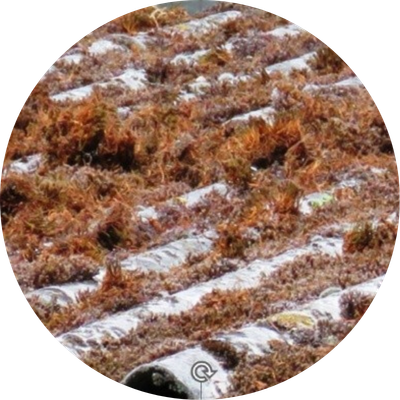
Another worry with asbestos cement roofs is the possibility of moss/lichen growth on the cement. This raises issues because when the moss detaches, an unsealed surface remains with loose asbestos fibres. Furthermore, the detached moss can easily spread with asbestos fragments attached, contaminating external and internal areas.
Another worry with asbestos cement roofs is the possibility of moss/lichen growth on the cement. This raises issues because when the moss detaches, an unsealed surface remains with loose asbestos fibres. Furthermore, the detached moss can easily spread with asbestos fragments attached, contaminating external and internal areas.
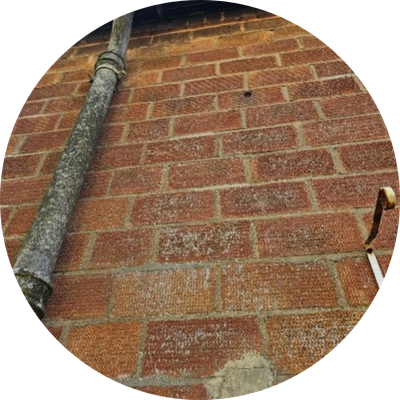
Additionally, asbestos cement products can deteriorate to the point where fibres are released and either travel or adhere to other surfaces. Note the grey fibrous marks to the wall below where rainwater has brought with it asbestos fibres from the cement roof & guttering.
Additionally, asbestos cement products can deteriorate to the point where fibres are released and either travel or adhere to other surfaces. Note the grey fibrous marks to the wall below where rainwater has brought with it asbestos fibres from the cement roof & guttering.
Across the globe, other governing bodies have implemented updated asbestos regulations and plans to eliminate ACMs.
In Flanders, Belgium, there is an ‘asbestos safe’ target of 2040 consisting of a phased approach to eliminate easily accessible friable materials and asbestos cement.
In France, it is mandatory to have an asbestos survey on all buildings at point of sale, leading to the vast majority of buildings removing all asbestos before being sold and gradually eliminating ACMs across France.
In the EU, as well as these measures from Belgium and France, the European Parliament has called for the removal of asbestos from all public buildings by 2028.
In Victoria, Australia, there is the Victorian Asbestos Eradication Agency (VAEA), established to prioritise and plan the removal of asbestos from government owned buildings in Victoria based on the lifespan of the ACMs.
Other areas across the globe have eradication plans to eliminate asbestos, whereas the UK only monitors our ACMs. In November 2019, the think tank ResPublica reviewed the current regulations and suggested the UK government is insufficiently safeguarding the public against the risks of asbestos. Further regulations are needed to phase in the safe removal of asbestos to effectively prevent exposure as the materials are beginning to reach the end of their lifespan, increasing the potential for harm.
There is currently no legal requirement for air monitoring as part of asbestos management, with the reinspection of ACMs typically being just a visual inspection. This is a limitation to the 2012 regulations as there is potential for airborne asbestos fibres when ACMs deteriorate. An update is needed to monitor the potential risk of airborne asbestos as well as the visual state of ACMs, as this is not part of the present inspection processes.
It is not adequate to solely rely on the reinspection of ACMs to assess their risk – many asbestos cement roofs are registered as managed and inspected, when safe removal is the more appropriate course of action to maintain a safe environment due to the asbestos lifespan. A more formal inspection process to identify the aging materials is needed to gradually eliminate the deteriorating asbestos instead of continuing to just manage it.
It is time for the UK’s approach to asbestos management to be reevaluated to ensure the risks surrounding asbestos are eradicated and a more appropriate elimination plan implemented.
For more information regarding SOCOTEC’s asbestos services, please contact us
Want to find out more...