

Enhancing Reservoir Dam Safety with Integrated GPR, EM & ERT Analysis
A civil engineering contractor commissioned SOCOTEC UK & Ireland to conduct a Ground Penetrating Radar (GPR) and Electromagnetic (EM) conductivity mapping survey at a reservoir based on the Scottish Borders.
The assessment was needed to identify two existing water mains and a third capped pipe which terminated at an unknown location and depth on-site as well as an assessment of the Dam structure itself.
Project Description and Overview
In July 2025, works commenced at the site, which comprised of a 130m x 35m area at the foot of the reservoir embankment.
Further goals of the works were to detect potential seepage pathways, void spaces, settlement areas. Key to the project was the use of non-invasive techniques that would damage critical infrastructure.
Solution
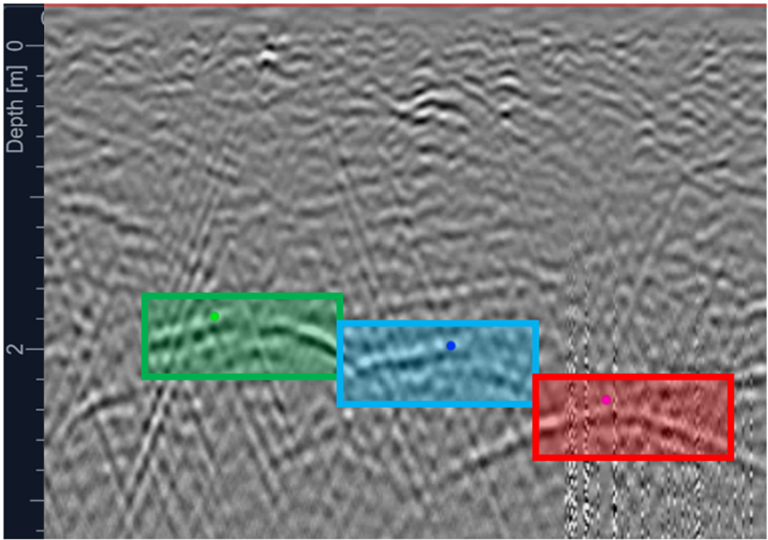
The resulting combined geophysical approach saw data collected with Electromagnetics (EM), Ground Penetrating Radar (GPR) and Electrical Resistivity Tomography (ERT).
The GPR utilised 200MHz and 450MHz antennas for deeper investigation into the structure whilst maximising resolution, with EM conductivity mapping and ERT in place for structural and conductivity assessments.
Metallic water mains are distinctive targets in this type of data, as their properties are hugely different from surrounding soils and trench backfill. It was decided that the GSSI SIR GPR systems, as well as the GF Instruments CMD explorer & Geophex GEM-2 electromagnetic conductivity meters, would be best suited in order to locate the targets.
GPR systems are well equipped to resolve near surface anomalies and anomalies at greater depths – up to 5-metres depth for large targets. The conductivity meters can detect variations in electromagnetic conductivity and magnetic susceptibility, which ultimately helps its users to map the target area.
Conclusion
SOCOTEC’s combination of the GPR/EM approach successfully delineated clay core boundaries, and found no significant void spaces or seepage pathways – mapping all water mains in question.
The dam structure was assessed as generally in good condition with only minor anomalies which required targeted investigation. The methodology established baseline data for future monitoring programmes, proving to be highly effective for non-intrusive dam assessment.
Think your project needs Integrated GPR, EM & ERT Analysis?
Discover our latest News & Media
Geophysics to Support Ground Investigation: Reduce Risk and Improve Ground Understanding

The Competency Framework for Fire Risk Assessors: The Practicalities

An Introduction to LSTC Group and Their Role in Nationally Significant Infrastructure Projects (NSIPs)

A Practical Guide to BS EN 13501-1 Classifications with UKTC
Bioremediation Field Applications: Delivering Effective In-Situ Remediation Solutions

SOCOTEC organises key antidisciplinary workshop to address concerns within AEC industry
Hydrographic Surveying: More Than Just Mapping the Seabed