Need some advice?
Leave your details and we will get in touch.
I want to be contacted by an expert
1 /

At SOCOTEC UK & Ireland, our Fire Damper inspection teams consistently find loft voids and roof spaces are among the locations where fire dampers are most frequently installed incorrectly or without adherence to manufacturer instructions.

Having inspected these areas across a wide range of building types, we see the same compliance gaps recurring, often in buildings where no one realises there is a problem until an inspection uncovers it.
UK guidance requires that fire-safety systems, including fire dampers, follow manufacturers' installation details and be assessed in line with fire-compartmentation drawings and the building's fire-risk assessment, as required under the Regulatory Reform (Fire Safety) Order 2005 and Building Regulations 2010 (Approved Document B).
In older buildings, we often find that these areas were omitted from historic compartmentation drawings altogether, making it tricky to determine the intended compartmentation strategy. This is precisely why our engineers approach every roof void and loft inspection with a forensic eye, because the drawings alone rarely tell the full story.

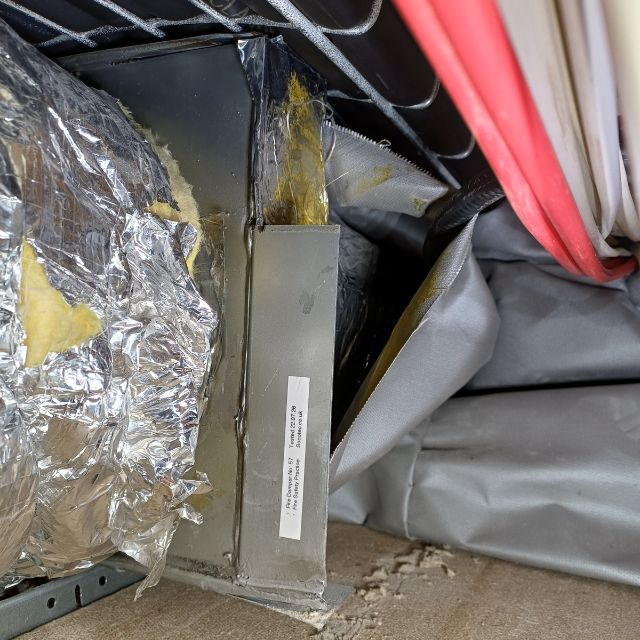
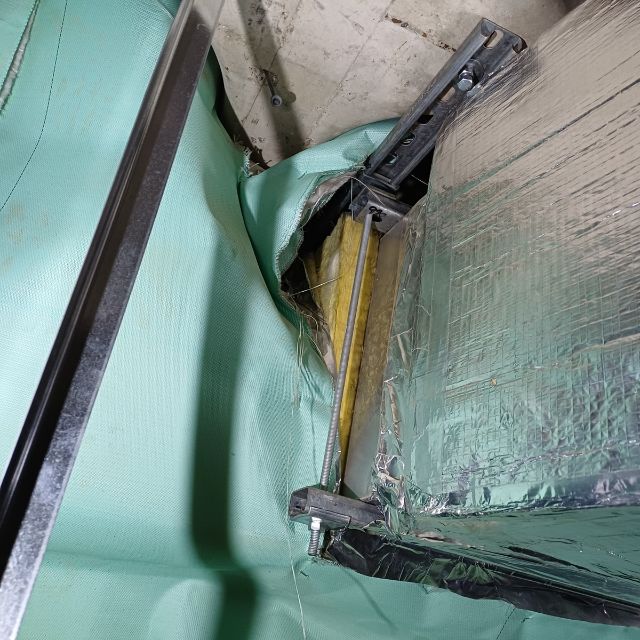
1. Dampers installed in mineral-wool fire curtains
Many damper manufacturers only recently obtained approval for installations in mineral-wool fire-curtain systems. Compliance must follow the manufacturer's tested installation method, as required under BS EN 1366-2 (fire-resistance testing of dampers) and BS EN 15650 (fire-damper product standard).
Our teams often flag that older installations cannot automatically be considered compliant simply because they have been in place for years, compliance needs to be determined by the tested method, not by age or apparent condition.
2.Dampers installed immediately after a ventilation grille in roof spaces, with no barrier present
Approved Document B requires that fire dampers be installed at every point where ductwork penetrates a fire compartment wall or floor, and always in their tested position relative to the barrier.
Where ceiling construction forms part of a fire compartment, the damper must be installed at the compartment line. When our engineers find a damper installed remotely from the barrier, it immediately raises questions about compartment rating, materials used, and whether the damper is even in the correct location to perform its function.
3. Dampers fixed into timber joists or beams
Timber fixing is incompatible with tested methods and therefore breaches BS EN 1366-2 requirements that dampers be installed exactly as tested in their supporting construction, typically concrete, drywall or masonry.
This is one of the clearest non-conformities our inspectors identify, as there is simply no test evidence to support a timber-fixed installation.
4. Floating dampers within ductwork inside undivided roof voids
A damper must be mounted in a fire-resisting barrier and cannot be left unsupported within a duct run. BS EN 1366-2 testing sets strict requirements for structural support and integrity, and a floating damper offers no validated fire-stopping performance whatsoever, regardless of how well it may operate mechanically.
In every case identified above, our approach is clear: the client must be informed, and corrective action taken to ensure dampers and associated fire barriers comply with UK legislation.
Legal duties fall under the Regulatory Reform (Fire Safety) Order 2005, the Building Safety Act 2022, and British Standards including BS 9999:2017, BS EN 1366-2 and BS EN 15650, all of which define inspection, installation and performance requirements.
Where compartmentation strategy is unclear or barrier types and damper specifications need re-assessing, SOCOTEC UK & Ireland can draw on qualified fire engineers to carry out that assessment.
For example, in sleeping-risk areas, Approved Document B and BS 9999 generally lead to the specification of motorised fire-and-smoke dampers, ensuring both smoke and fire control are properly addressed.
Our inspection teams are trained to remember that a drop test is only one aspect of a full inspection. BS EN 1366-2, BS EN 13501-3 and DW 145 (the BESA inspection standard) all emphasise that installation compliance is just as critical as functional performance in a fire event, a damper that drops correctly during a test but was never installed to its tested configuration cannot be relied upon in a real fire.
Want to find out more about Fire Dampers...