
SOCOTEC carried out award-winning whole-life carbon retrofit on a Barcelona industrial building
Challenge
The Fundación Daniel y Nina Carasso required comprehensive sustainability consultancy to transform a former industrial building in Barcelona into their new headquarters and community hub.
The Foundation required quantified carbon evidence, which included robust, benchmark-referenced data, which demonstrated the carbon benefits of retrofit versus new build. There was also the necessity for compliance with standards, which saw assessments aligned with EN 15978 and EN 15804 standards take place.

Project Description/Background
The need for data suitable for external communication, was to help fund applications and sustainability reporting, as well as BREEAM certification to provide evidence to support green building certification requirements.
A holistic carbon assessment was required to provide integrated analysis, including operational, embodied and biogenic carbon impacts.
The Foundation sought to demonstrate that rehabilitation could be a powerful decarbonisation strategy while creating a functional, sustainable headquarters that aligned with environmental values.
Project Description/Background
The need for data suitable for external communication, was to help fund applications and sustainability reporting, as well as BREEAM certification to provide evidence to support green building certification requirements.
A holistic carbon assessment was required to provide integrated analysis, including operational, embodied and biogenic carbon impacts.
The Foundation sought to demonstrate that rehabilitation could be a powerful decarbonisation strategy while creating a functional, sustainable headquarters that aligned with environmental values.

Solution
When approached, SOCOTEC Spain delivered an integrated whole-life carbon consultancy service, combining dynamic energy modelling and life-cycle assessment in order to provide a complete carbon picture.
SOCOTEC’s experts began by assessing the building and developing a thorough methodology that aimed to address all the Foundation’s requirements. With the use of DesignBuilder software, SOCOTEC modelled the building's energy performance, and was able to produce a near net-zero operational strategy.
Embodied carbon assessments were a key part of this strategy, with one-click LCA used to calculate lifecycle impacts across all building elements, materials, and construction phases. From there, results were compared against the Area Metropolitana de Barcelona (AMB) and London Energy Transformation Initiative (LETI) benchmarks, in order to provide context and validation.
The carbon sequestration benefits of bio-based materials (timber and cork insulation) were quantified, while all assessments were aligned with EN 15978 (sustainability assessment of construction works) and EN 15804 (environmental product declarations), ensuring compliance was met.
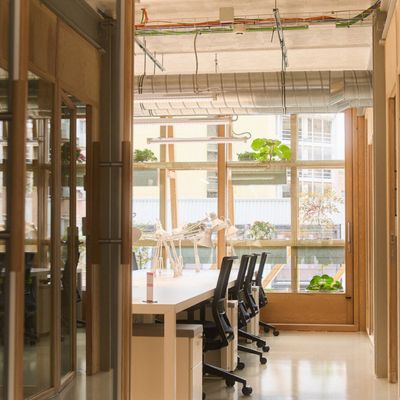
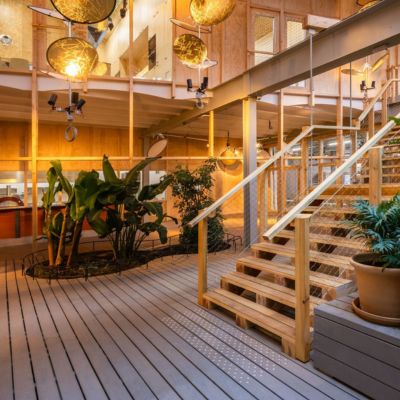
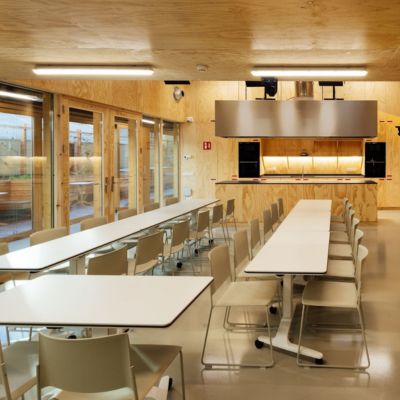
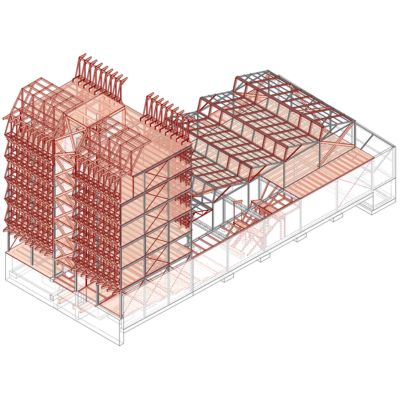
The retrofit works prioritised the preservation of the existing industrial structure to avoid demolition emissions, while the intention was set to use reusable materials, in particular specifying the timber-frame façade and cork insulation was used to reduce embodied carbon and capture biogenic carbon.
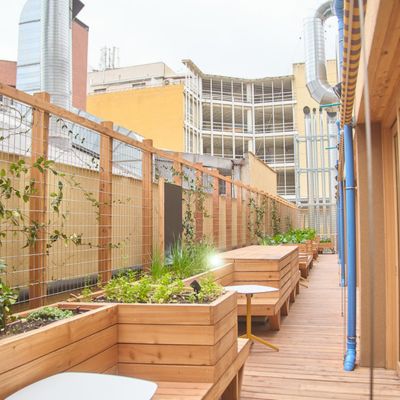
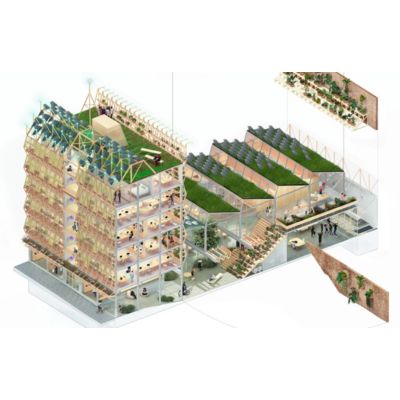
The incorporation of green roofs and rooftop photovoltaic systems was also prioritised, along with water efficiency, with measures implemented to help achieve a total saving of 28.5% in water.
Solution
When approached, SOCOTEC Spain delivered an integrated whole-life carbon consultancy service, combining dynamic energy modelling and life-cycle assessment in order to provide a complete carbon picture.
SOCOTEC’s experts began by assessing the building and developing a thorough methodology that aimed to address all the Foundation’s requirements. With the use of DesignBuilder software, SOCOTEC modelled the building's energy performance, and was able to produce a near net-zero operational strategy.
Embodied carbon assessments were a key part of this strategy, with one-click LCA used to calculate lifecycle impacts across all building elements, materials, and construction phases. From there, results were compared against the Area Metropolitana de Barcelona (AMB) and London Energy Transformation Initiative (LETI) benchmarks, in order to provide context and validation.
The carbon sequestration benefits of bio-based materials (timber and cork insulation) were quantified, while all assessments were aligned with EN 15978 (sustainability assessment of construction works) and EN 15804 (environmental product declarations), ensuring compliance was met.
The retrofit works prioritised the preservation of the existing industrial structure to avoid demolition emissions, while the intention was set to use reusable materials, in particular specifying the timber-frame façade and cork insulation was used to reduce embodied carbon and capture biogenic carbon.
The incorporation of green roofs and rooftop photovoltaic systems was also prioritised, along with water efficiency, with measures implemented to help achieve a total saving of 28.5% in water.

Conclusion
SOCOTEC provided the Foundation with a single, integrated whole-life carbon picture, built on recognised tools and standards, with clear benchmarks against AMB and LETI references.
Dealing with a floor area of approximately 2,780 m², it was clear the project would be no mean feat. So with that in mind, the fact that approximately 52% lower whole-life carbon was used than the new build equivalent, with an initial embodied carbon of 240 kgCO₂e/m² – about 56% below the regional benchmark – is fantastic news.
The credible data that the Foundation could use for funding applications and grant submissions, sustainability reporting and ESG disclosure, BREEAM certification evidence and external communication and stakeholder engagement, was also provided.
This robust and thorough level of carbon data helped promote the project to recognition in the prestigious Holcim Awards for sustainable construction.
Much as SOCOTEC’s initial assessment suggested, the results demonstrated that retrofit dramatically outperforms new build as a decarbonisation strategy, supporting the Foundation's environmental mission and decision-making in the process.
Conclusion
SOCOTEC provided the Foundation with a single, integrated whole-life carbon picture, built on recognised tools and standards, with clear benchmarks against AMB and LETI references.
Dealing with a floor area of approximately 2,780 m², it was clear the project would be no mean feat. So with that in mind, the fact that approximately 52% lower whole-life carbon was used than the new build equivalent, with an initial embodied carbon of 240 kgCO₂e/m² – about 56% below the regional benchmark – is fantastic news.
The credible data that the Foundation could use for funding applications and grant submissions, sustainability reporting and ESG disclosure, BREEAM certification evidence and external communication and stakeholder engagement, was also provided.
This robust and thorough level of carbon data helped promote the project to recognition in the prestigious Holcim Awards for sustainable construction.
Much as SOCOTEC’s initial assessment suggested, the results demonstrated that retrofit dramatically outperforms new build as a decarbonisation strategy, supporting the Foundation's environmental mission and decision-making in the process.
Want to find out more about Carbon Retrofit...
Discover our latest News & Media
Geophysics to Support Ground Investigation: Reduce Risk and Improve Ground Understanding

The Competency Framework for Fire Risk Assessors: The Practicalities

An Introduction to LSTC Group and Their Role in Nationally Significant Infrastructure Projects (NSIPs)

A Practical Guide to BS EN 13501-1 Classifications with UKTC
SOCOTEC Engineering Conference returns for successful London edition
Bioremediation Field Applications: Delivering Effective In-Situ Remediation Solutions
SOCOTEC organises key antidisciplinary workshop to address concerns within AEC industry

Hydrographic Surveying: More Than Just Mapping the Seabed