Concrete Condition Testing of a Concrete Frame Building
Challenge
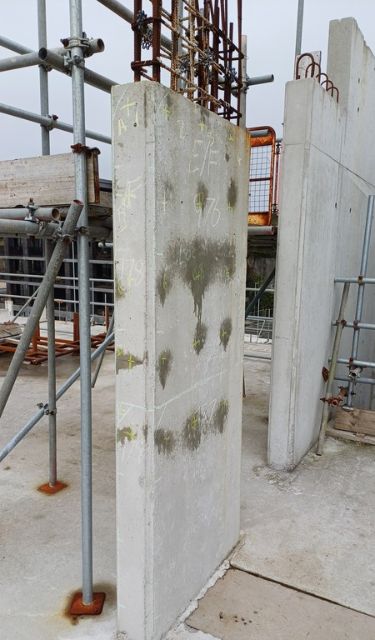
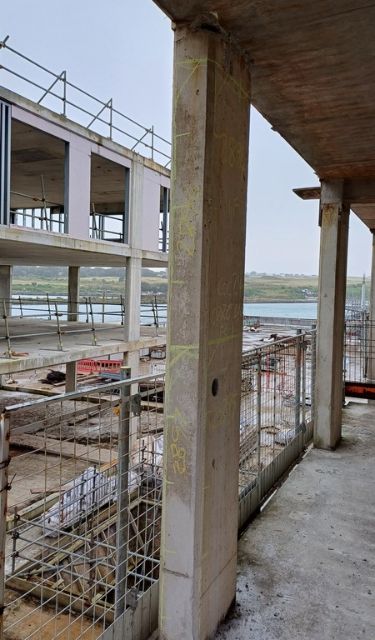
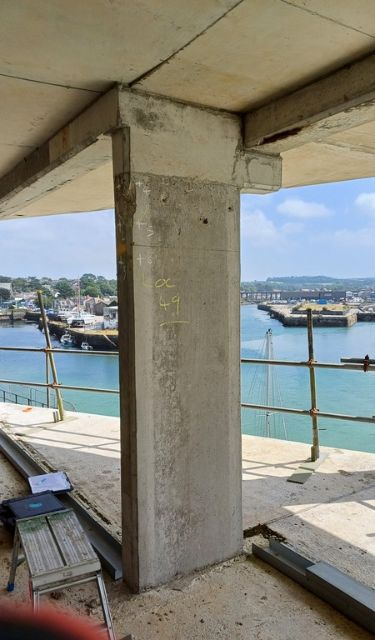
SOCOTEC UK and Ireland was appointed to conduct detailed concrete condition testing across five unfinished buildings at a UK quay site. The assessment required thorough evaluation of concrete condition and reinforcement detail through a combination of intrusive and non-intrusive investigation techniques.
Project Description and Background
The quay structures required investigation to assess their current condition and remaining service life. As the structures had been unfinished, concrete was exposed over time, close to the sea. Therefore the scope encompassed corrosion assessment, concrete strength verification, reinforcement mapping, and durability testing. SOCOTEC's Structures and Pavements team coordinated all field investigation activities and laboratory testing services to deliver a complete assessment of the structures.

Solution
SOCOTEC implemented a testing programme which incorporated both field investigation and laboratory analysis across the five structures. The investigation methodology combined non-destructive survey techniques with selective intrusive testing to characterise the condition of the concrete and the properties of the reinforcement.
Based on the location of the site, corrosion assessment formed a key element of the investigation, with half-cell potential mapping conducted to identify areas of potential reinforcement corrosion. Concrete cover depth measurements verified protection levels for embedded reinforcement, while resistivity testing assessed the concrete's ability to sustain corrosion activity. Carbonation depth testing determined the extent of concrete carbonation and its proximity to the reinforcement level.
Ferroscan electromagnetic imaging surveys were performed to map reinforcement layouts and verify bar sizes. This non-destructive approach was complemented by targeted reinforcement breakouts at selected locations to provide visual verification of reinforcement condition and validate the imaging survey results. Reinforcement logging documented bar sizes, spacing, and condition throughout the structures.
Concrete strength was assessed through extraction and testing of concrete cores, with compressive strength testing performed under UKAS-accredited laboratory conditions.
Ultrasonic pulse velocity measurements provided additional assessment of concrete quality and uniformity across structural elements. Rebound hammer testing offered supplementary hardness data across accessible concrete surfaces.
All intrusive investigation locations, including core holes and reinforcement breakouts, were professionally reinstated following completion of testing. Chloride ion analysis of concrete samples identified any contamination from marine exposure. The comprehensive laboratory testing programme complemented field investigation activities to deliver complete characterisation of concrete condition and durability parameters.
Conclusion
The quay site investigation demonstrates SOCOTEC's ability to deliver integrated concrete condition assessments combining advanced non-destructive testing with targeted intrusive investigation. The thorough testing programme provided detailed data on concrete quality, reinforcement condition, and durability performance across multiple structures.
SOCOTEC's multidisciplinary approach leveraged in-house testing capabilities, UKAS-accredited protocols, and experienced field teams to ensure high-quality data collection and analysis. The project exemplifies efficient coordination between site investigation activities and laboratory testing services, providing clients with complete structural assessment through a single point of contact.
Want to find out more about SOCOTEC's Infrastructure projects...
Discover our latest News & Media



An Introduction to LSTC Group and Their Role in Nationally Significant Infrastructure Projects (NSIPs)
Bioremediation Field Applications: Delivering Effective In-Situ Remediation Solutions

SOCOTEC UK & Ireland Celebrates Double Success at the Ground Engineering Awards